Sunset Beach NC Real Estate Market: Island vs. Mainland
September 10, 2026
September 10, 2026
Two buyers call about a home in Sunset Beach this month. One has a budget of $320,000 and wants a low-maintenance condo near a golf course. The other has $850,000 and wants to hear the ocean from the porch. Both are shopping in the same town. Both will end up in completely different real estate markets, with different insurance bills, different rules about whether they can rent the place out, and almost nothing in common except a mailing address.
That is the part the median price does not tell you. Look up Sunset Beach on any market snapshot and you will get a single number that sounds authoritative and explains almost nothing.
Resideline's tracking of closed sales in Sunset Beach through August 2026 put the median at $437,500 across 203 closings over the prior six months, but the middle half of those sales closed anywhere from $275,000 to $635,000. That is not a narrow band around a typical home. That is two markets colliding.
A median that wide is a signal, not a summary. It means the town-wide number is doing very little work, and a buyer who anchors on it without asking where in Sunset Beach they are actually looking is comparing the wrong things.
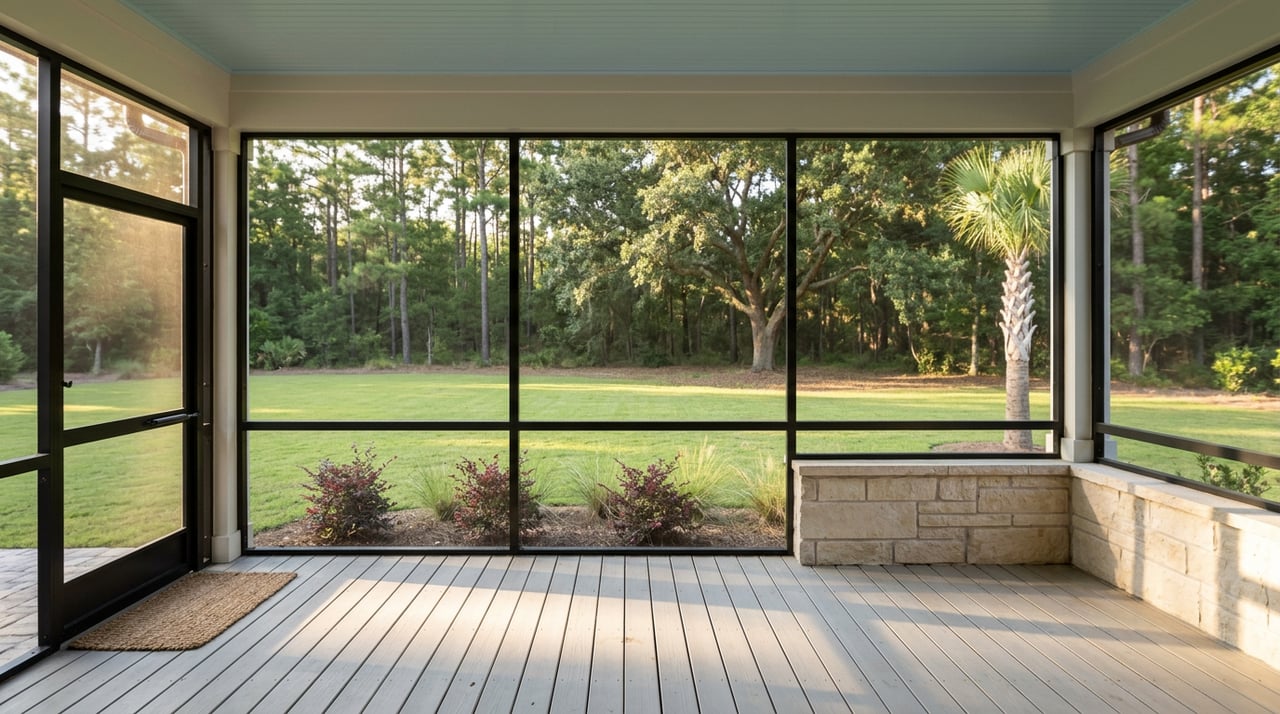
Sunset Beach is split by geography in a way that shapes price more than almost anything else about the property itself. The island holds the oceanfront and near-ocean homes. The mainland side, reached by the high-rise bridge that replaced the old one-lane pontoon swing bridge in 2011, holds the golf-course communities, chiefly Sea Trail Plantation and Sandpiper Bay.
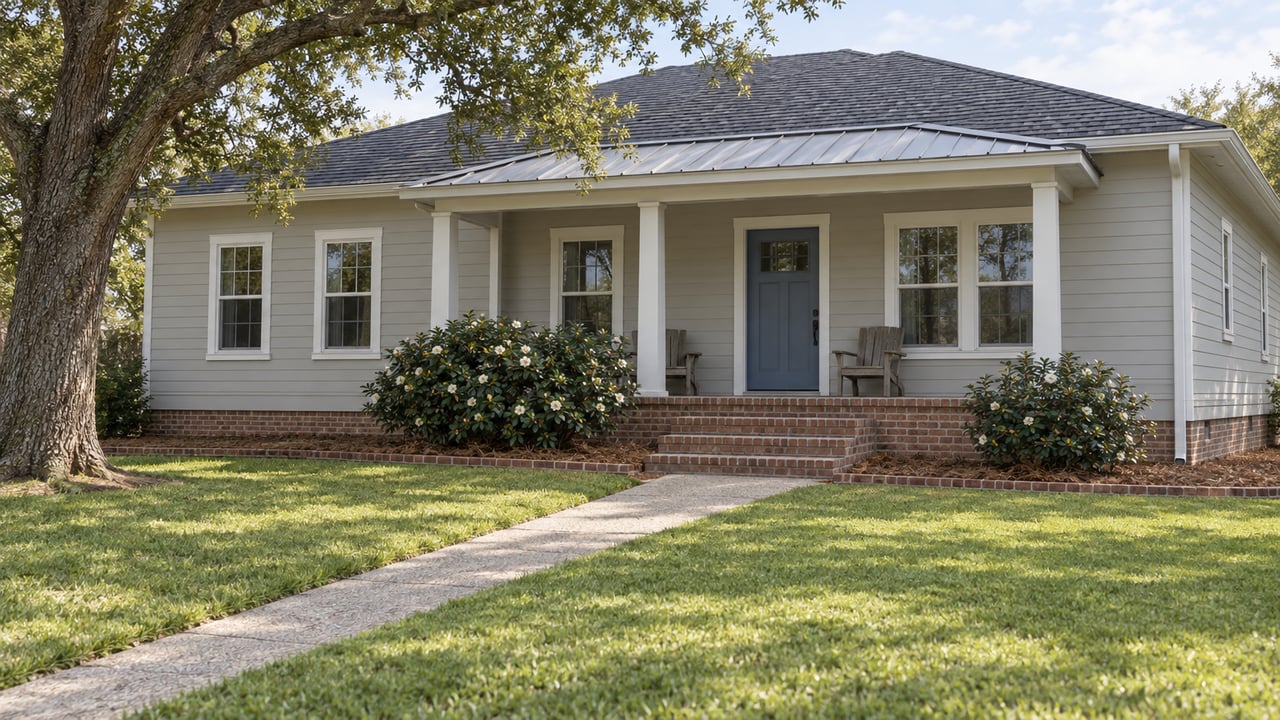
These two sides of town sell at fundamentally different price floors. On the mainland, condos in the golf communities commonly start in the mid $200,000s and run into the high $300,000s for larger three-bedroom units, with single-family homes typically starting in the high $300,000s. These are amenity-heavy, low-maintenance properties built around 54 combined holes of golf across Sea Trail's three championship courses and Sandpiper Bay's 27-hole layout, plus pools, tennis, and clubhouses that spread the maintenance burden across an HOA rather than a single owner.
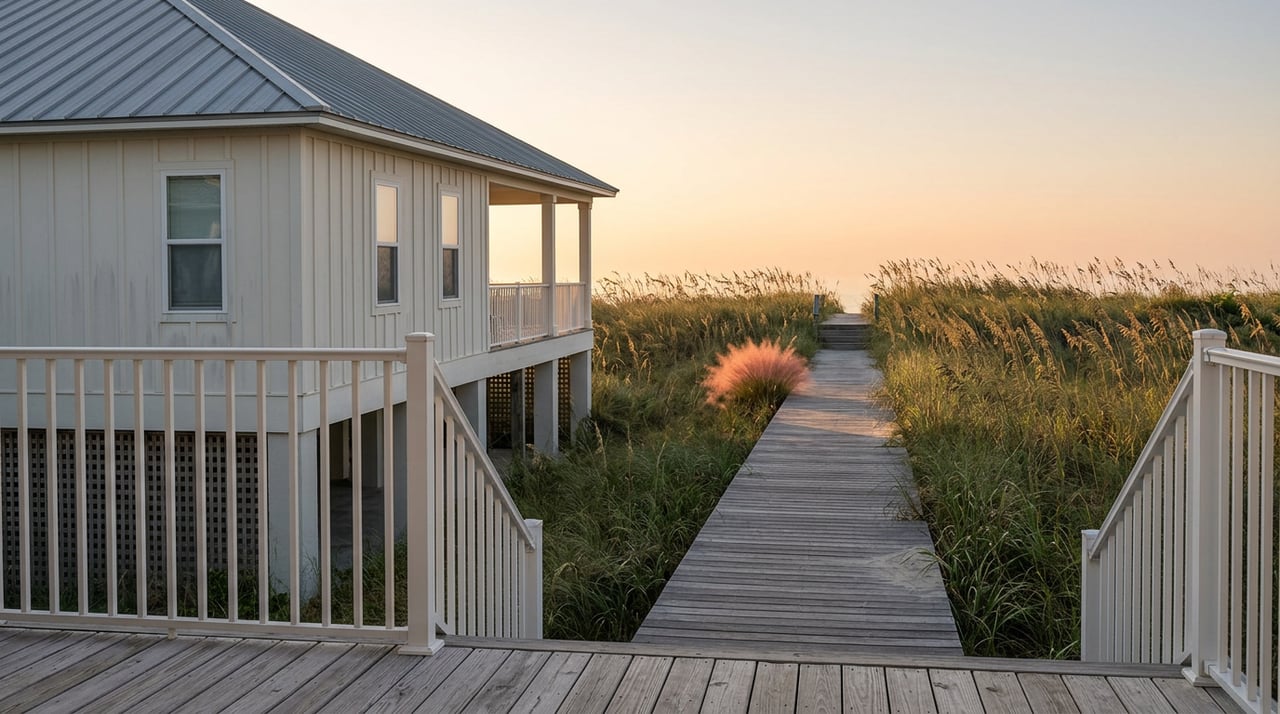
On the island, direct oceanfront or prime beach access starts closer to the high $700,000s and climbs well into seven figures, largely because supply is fixed. Sunset Beach is a barrier island a few miles long, and there is no meaningful way to add more oceanfront lots. Realtors Property Resource data pegged the April 2026 single-family median for Sunset Beach at $513,015, sitting well above the Brunswick County single-family median of $404,103 recorded that May, and that gap exists precisely because the island half of town pulls the town-wide number upward while the mainland golf communities pull it back down.
So when a buyer sees "$437,500 median" and assumes that describes a typical home, they are really seeing the midpoint of two distributions that barely overlap. A property at $300,000 and a property at $650,000 can both be perfectly normal for Sunset Beach. They are just normal for different Sunset Beaches.
The price gap is the visible part of the split. The insurance gap is the part that catches buyers off guard after closing.
Most coastal North Carolina beach homes need three separate insurance policies to be fully covered: a standard homeowners policy for fire and liability, a wind and hail policy through the state-created North Carolina Insurance Underwriting Association, commonly called the Beach Plan, and a flood policy through the National Flood Insurance Program or a private flood carrier. No single policy covers all three perils, and the combined cost of that three-policy stack for an oceanfront North Carolina home has risen 25 to 40 percent since 2022, driven by reinsurance costs, storm losses, and the recalculated risk pricing under FEMA's Risk Rating 2.0 methodology.
Where a property sits inside Sunset Beach changes which side of that cost curve it lands on. Homes directly on the ocean, in flood zones V or VE, carry the highest wind and flood premiums in the state's coastal territory. Mainland golf-community homes sit farther from the surf and often at different elevations, which typically means a smaller flood insurance line item and, in many cases, no mandatory Beach Plan wind policy at all if the property falls outside the designated coastal wind territory.
That difference matters for anyone building a real ownership budget rather than just a mortgage calculation. A buyer comparing a $600,000 island cottage to a $500,000 mainland golf-community home is not just comparing purchase price. They are comparing two different annual carrying costs layered on top of it, and the gap between those carrying costs can be large enough to change which property is actually the better value.
| Mainland Golf Communities (Sea Trail, Sandpiper Bay) | Island Oceanfront | |
|---|---|---|
| Typical price floor | Condos from the mid $200,000s; homes from the high $300,000s | Direct oceanfront from the high $700,000s into seven figures |
| Flood zone exposure | Generally lower risk, often outside V/VE zones | Frequently in V or VE zones, the highest-risk coastal designation |
| Insurance structure | Standard homeowners policy, flood coverage often optional or lower cost | Three-policy stack common: homeowners, Beach Plan wind, NFIP or private flood |
| Short-term rental posture | Some HOAs restrict or prohibit short-term rentals to preserve a residential feel | Strong short-term rental demand, though individual complex rules still apply |
The third layer of the split is the one most likely to derail a buyer's plans if they assume the rules are the same on both sides of the bridge: whether the property can be rented short-term at all.
North Carolina law actually limits how much a town government can restrict short-term rentals. The 2022 Schroeder v. City of Wilmington decision, combined with N.C.G.S. 160D-1207(c), preempts municipalities from imposing their own registration caps or lotteries on short-term rentals, which means Sunset Beach as a town cannot simply ban them outright the way some other coastal towns have tried to. But that state-level protection only reaches town ordinances. It does not touch what a private homeowners association can do inside its own governing documents, and this is where the real divide in Sunset Beach shows up.
Under North Carolina's Planned Community Act, an HOA can adopt rental restrictions, including caps on the total number of units rented at once, minimum lease terms, or outright prohibitions on short-term rentals, as long as those rules are written into the association's declaration and properly adopted by the membership. Some of the mainland golf communities have gone exactly that route, prohibiting short-term rentals to keep the neighborhood feeling residential rather than transient. Island properties, by contrast, tend to carry strong short-term rental demand and complex-by-complex rules that are far more permissive, which is part of why island units command a premium from buyers who want rental income alongside personal use.
The practical takeaway is that "can I rent this out" is not a Sunset Beach question. It is a specific-property question that depends on which HOA's declaration governs the parcel, and that declaration has to be pulled and read before an offer goes in, not assumed from the town's general reputation as a vacation destination.
The mistake is treating Sunset Beach as one line on a spreadsheet. A buyer who wants low-maintenance golf access and does not need rental income is shopping a genuinely different market than a buyer chasing oceanfront appreciation and short-term rental yield, even though both listings say "Sunset Beach, NC" at the top.
The better first question is not "what's the median price" but "which side of town, and under which HOA." That single distinction changes the entry price by hundreds of thousands of dollars, changes the annual insurance bill by thousands, and changes whether the property can generate rental income at all. Getting that answer before writing an offer saves a buyer from discovering the real cost of ownership after closing, when there is far less room to adjust.
Is the mainland side of Sunset Beach actually part of the town, or is it a separate community? It is the same municipality. Sunset Beach spans both the barrier island and a mainland section that includes the golf communities, connected by the town's high-rise bridge.
Does every mainland golf community ban short-term rentals? No. Rental rules are set at the individual HOA level under the community's own governing documents, so a buyer has to check the specific declaration for the community in question rather than assume a town-wide policy.
Why did flood insurance costs rise so much industry-wide in recent years? FEMA's Risk Rating 2.0 methodology recalculates flood premiums based on individual property risk factors like elevation and distance from water rather than flood zone alone, and combined with rising reinsurance costs, that has pushed coastal premiums higher across North Carolina since 2022.
Whether the right fit turns out to be a golf-course condo on the mainland or an oceanfront home on the island, the numbers only make sense once you know which market you are actually comparing. Natalie Rakoci has spent years working both sides of Sunset Beach's bridge and can walk through the price, insurance, and rental picture for the specific property you have in mind. Let's Connect.
Stay up to date on the latest real estate trends.

With deep market knowledge across North and South Carolina, Natalie Dawn Rakoci delivers a refined real estate experience built on trust, strategy, and results. Whether buying, selling, or investing, clients receive personalized guidance and expert representation every step of the way.
NATALIE DAWN RAKOCI
4705 Oleander Dr Ste C Myrtle Beach, SC 29577 MON - SUN 8:00 AM - 7:00 PM